If you’ve ever ordered a Blue Lagoon, a Blue Hawaiian, or wondered why a cocktail is glowing an electric shade of blue, you’ve met blue curaçao. It’s one of the most recognizable ingredients behind the bar and famous for its color as much as its flavor, but most people don’t actually know what it’s made from or where it comes from. Here’s everything you need to know.
The Origins: Curaçao the Island, Curaçao the Liqueur
Curaçao liqueur takes its name from the Caribbean island of Curaçao, off the coast of Venezuela. The island is home to the laraha citrus fruit, a bitter, inedible orange that grows almost nowhere else. Dutch settlers discovered that the dried peel of the laraha, despite the fruit itself being too bitter to eat, produced a fragrant oil once processed, and that oil became the base for a distinctive orange liqueur.
Traditional curaçao liqueur is made by macerating or distilling these dried orange peels with a neutral spirit, then sweetening the result. On its own, it’s a clear or amber-colored liqueur with a bittersweet orange flavor.
So Why Is It Blue?
Here’s the twist: curaçao isn’t naturally blue. The blue color is added, typically with a food-safe dye. The blue version was popularized in the mid-20th century as a marketing move — bartenders and brand producers realized that a vividly colored liqueur could make cocktails look as striking as they tasted, and “blue curaçao” was born as a category of its own.
Blue curaçao tastes essentially the same as standard (clear or orange) curaçao — orange peel, citrus, a touch of sweetness — the color is purely cosmetic. It’s what gives drinks like the Blue Hawaiian, Blue Lagoon, and Purple Rain their signature tropical-ocean hue.
What Does Blue Curaçao Taste Like?
Expect:
- Bright orange peel notes, both sweet and slightly bitter
- A clean, citrusy sweetness rather than a heavy, syrupy one
- Low-to-moderate alcohol content, usually in the 15–25% ABV range, making it easy to mix
- A triple-sec-adjacent flavor profile. Many people compare it directly to triple sec or orange curaçao, just blue
It’s typically used in small amounts as a mixer or modifier, not sipped on its own, though it can be enjoyed neat or on ice.
Common Uses for Blue Curaçao
- Cocktails: Blue Lagoon, Blue Hawaiian, Blue Margarita, Purple Rain, Screwball.
- Baking and desserts (cakes, macarons, drizzles) where a pop of blue is wanted
- Layered shots, thanks to its distinct color separating visually from other spirits
A Modern Alternative: Mouse Kingdom Blue Liqueur
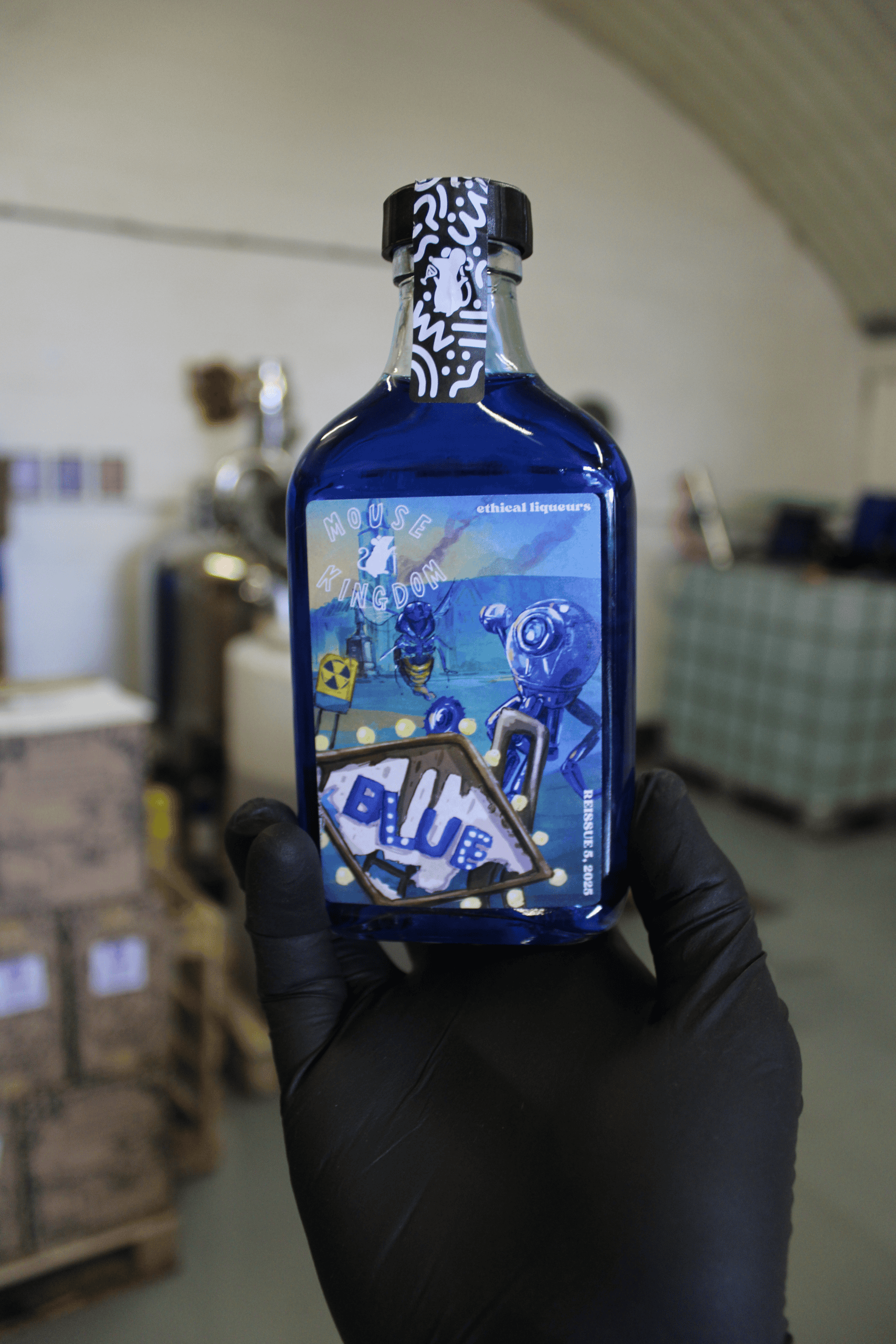
If you’re shopping for blue curaçao today, you’ll likely come across Mouse Kingdom Blue Liqueur, a Manchester-made ethical citrus liqueur that’s positioned as a direct substitute. It’s built from winter wheat, lemon, grapefruit, and both bitter and sweet orange peel, giving it a citrus-forward profile designed to work as an alternative to traditional blue curacao in cocktails.
It’s also the only blue curacao made from rescued waste juiced fruit. Every week bars in Manchester juice, and on the day that they juice Mouse Kingdom Liqueurs collects the waste peel via ebike. The peel is hand sorted, cleaned and then goes straight into their 380L pot still to distil their next batch.
It’s bottled at 70cl and 20% ABV, and available both on their website, and the Whiskey Exchange, in the UK:
Mouse Kingdom Blue on the Whiskey Exchange
What makes it a useful stand-in:
- Citrus complexity: Combining grapefruit and lemon alongside orange peel gives it a slightly more layered profile than some mass-market blue curaçaos, which can lean one-note sugary-orange.
- Drop-in usability: It’s designed to work in the same recipes — Blue Lagoons, Blue Margaritas, Purple Rains — without adjusting your ratios.
- Part of a wider range: Mouse Kingdom also produces liqueurs in flavors like strawberry, passion fruit, coffee, and orange marmalade quad sec, so if you like the blue one, there’s a broader lineup worth exploring for your home bar.
Blue Curaçao vs. Triple Sec vs. Regular Curaçao — What’s the Difference?
| Liqueur | Color | Base Flavor | Common Use |
|---|---|---|---|
| Curaçao (traditional) | Clear/amber | Bitter orange peel | Classic cocktails, orange-forward drinks |
| Blue Curaçao | Bright blue | Same as above, dyed | Tropical/visual cocktails |
| Triple Sec | Clear | Sweeter orange | Margaritas, sours |
In practice, blue curaçao and triple sec are close enough in flavor that they’re often used interchangeably as the real differentiator is color, not taste.
Quick FAQ
Is blue curaçao alcoholic?
Yes — most bottles range from 15–25% ABV, though this varies by brand.
Does blue curaçao stain?
The dye can stain light fabrics if spilled, so it’s worth being a little careful when pouring.
Can I substitute blue curaçao with something else?
Yes. Triple sec plus a drop of blue food coloring is a classic hack, or you can use a purpose-made alternative like Mouse Kingdom Blue Liqueur, which is formulated specifically to replace it in recipes.
Is blue curaçao vegan?
Most brands are, but always check the label, since some clarifying or coloring agents vary by producer.
Leave a Reply